logo

Dr. Vishwanath Karad MIT World Peace University, Pune
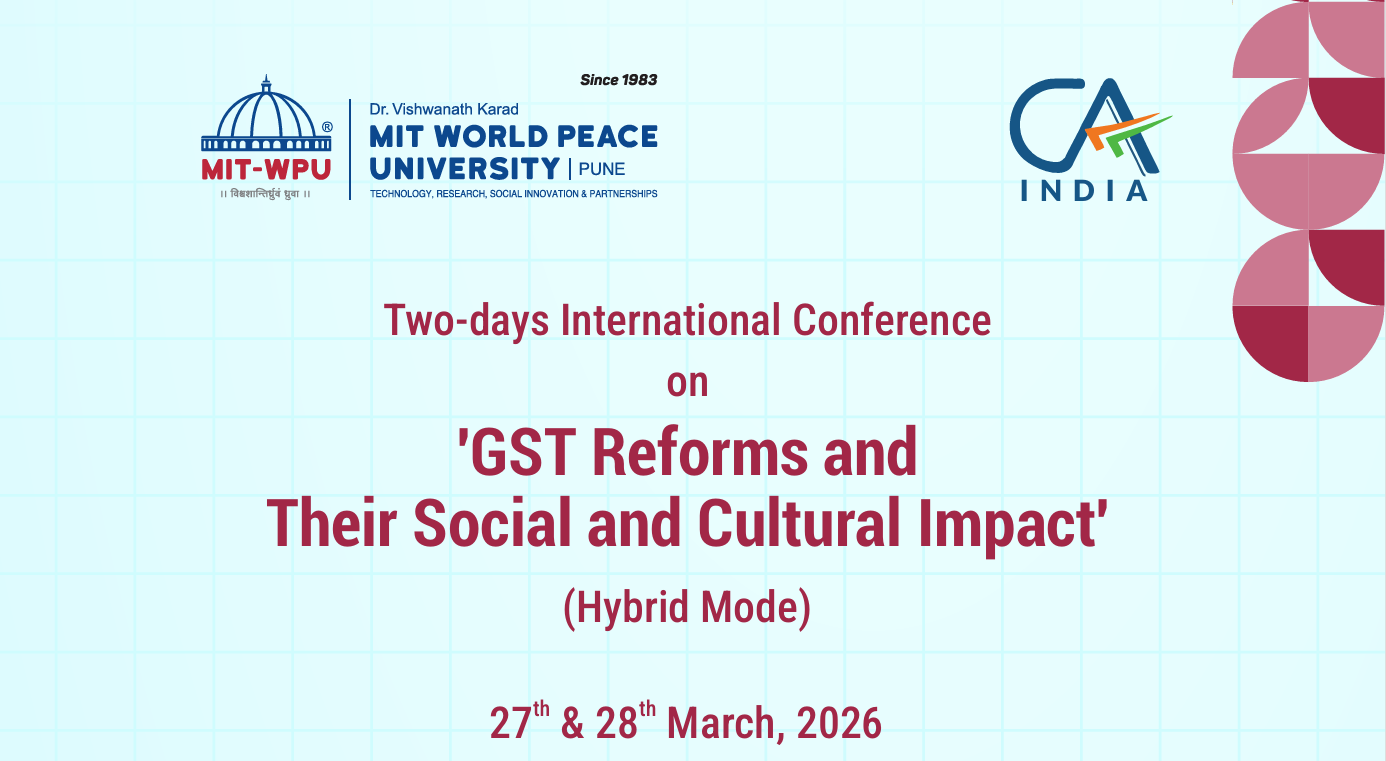
Organising Two-days International Conference on
GST Reforms and Their Social and Cultural Impact
Conference Date: 23th-24th March 2026 | Mode: Hybrid (Offline+Online)


Register Now


Tracks

  • Track 1: Finance, Tax compliance and Enterprise Resilience
  • Track 2: Marketing, Consumption Patterns and Cultural Symbolism
  • Track 3: Human Resource Management and Informal Labour Transitions
  • Track 4: Operations, Supply Chains, and Regional Industrial Networks
  • Track 5: Strategy, Competitive Dynamics, and Market Structure
  • Track 6: Information Systems, Digitalization, and Financial Literacy
  • Track 7: Legal, Governance, and Institutional Adaptation
  • Track 8: Corporate Social Responsibility, Ethics, and Community Relations
  • Track 9: Sectoral Deep-Dives: Industry-Specific Social-Cultural Impacts


About the Conference

The School of Economics and Commerce, MIT World Peace University, Pune will host a Two-Day International Conference on “GST Reforms and Their Social and Cultural Impact” on 27–28 March 2026 in hybrid mode. The conference will highlight how GST has reshaped India's economic and social fabric, influencing industries, communities, and cultural practices beyond taxation. With a multidisciplinary lens, discussions will address MSMEs, artisan clusters, informal labour, consumption shifts, and digital inclusion, while examining variations across gender, caste, and regions. By engaging academia, industry, policymakers, and civil society, the event seeks to foster dialogue on balancing tax efficiency with social equity and cultural sensitivity.

Objectives

  1.  To map social and cultural consequences of GST across major Indian industries.
  2.  To examine discipline-specific impacts across the fields of finance, marketing, HR, operations, strategy, IT, and law.
  3. To identify variations in outcomes across gender, caste, region, and enterprise size.
  4. To propose inclusive policies, capacity-building measures, and culturally informed implementation strategies.
  5. To grasp the influence of GST policies on economic conduct, job opportunities, and the well-being of families.
  6. To strengthen interdisciplinary research and dialogue among academia, industry, government, and civil society.

Objectives


About the Conference

The School of Economics and Commerce, MIT World Peace University, Pune will host a Two-Day International Conference on “GST Reforms and Their Social and Cultural Impact” on 27–28 March 2026 in hybrid mode. The conference will highlight how GST has reshaped India's economic and social fabric, influencing industries, communities, and cultural practices beyond taxation. With a multidisciplinary lens, discussions will address MSMEs, artisan clusters, informal labour, consumption shifts, and digital inclusion, while examining variations across gender, caste, and regions. By engaging academia, industry, policymakers, and civil society, the event seeks to foster dialogue on balancing tax efficiency with social equity and cultural sensitivity.

Objectives

  1.  To map social and cultural consequences of GST across major Indian industries.
  2.  To examine discipline-specific impacts across the fields of finance, marketing, HR, operations, strategy, IT, and law.
  3. To identify variations in outcomes across gender, caste, region, and enterprise size.
  4. To propose inclusive policies, capacity-building measures, and culturally informed implementation strategies.
  5. To grasp the influence of GST policies on economic conduct, job opportunities, and the well-being of families.
  6. To strengthen interdisciplinary research and dialogue among academia, industry, government, and civil society.

Program Schedule

Important Dates

Abstract Submission
Last Date 12th Feb 2026
Acceptance of Abstract 15th Feb 2026
Full Paper Submission
Last Date 07th Mar 2026
Acceptance of Paper 14th Mar 2026
Registration
Last Date 17th Mar 2026
Conference Dates 27th -28th  Mar 2026


Tracks & Sub-tracks


Conference Themes and Sub Themes

The broad theme of the conference is “GST Reforms and Their Social and Cultural Impact,” which  encompasses the range of sub-themes, including but not limited to the following:

Track 1: Finance, Tax compliance and Enterprise Resilience

  • Working Capital Dynamics and Strategic Pricing under GST
  • Financial Access and Compliance Burden for MSMEs
  • Socio-Economic Impact on Micro-Entrepreneurs and Gendered Financial Responsibilities
  • Sectoral Perspectives: Manufacturing, MSMEs, Agri-Value Chains, and Construction

Track 2: Marketing, Consumption Patterns and Cultural Symbolism

  • Consumer Behavior and Cultural Spending Patterns
  • Adaptive Branding, Category Management, and Retail Innovation
  • Market Responses in Crafts, Textiles, and Traditional Food Segments
  • Sectoral Focus: Retail, FMCG, Handicrafts, Textiles, and E-Commerce

Track 3: Human Resource Management and Informal Labour Transitions

  • Labour Formalization, Contractual Shifts, and Reskilling Imperatives under GST
  • Human Resource Strategies for Social Protection and Inclusive Workplaces
  • Gendered Occupations and Preservation of Traditional Skill Transmission
  • Sectoral Insights: Construction, Hospitality, Textiles, Healthcare, and Informal Services

Track 4: Operations, Supply Chains, and Regional Industrial Networks

  • Input Tax Credit Flows and Supply Chain Optimization
  • Restructuring Supplier Networks and Regional Production Clusters
  • Sectoral Perspectives: Automotive, Electronics, Pharmaceuticals, Agro-Processing, and Logistics

Track 5: Strategy, Competitive Dynamics, and Market Structure

  • Economies of Scale, Market Consolidation, and MSME Strategic Adaptations
  • Corporate Repositioning and Incentive-Driven M&A Trends
  • Balancing Cultural Homogenization with Regional Specialization
  • Sectoral Focus: Organized Retail vs. Kirana, Media, and Services

Track 6: Information Systems, Digitalization, and Financial Literacy

  • Digital Integration and Readiness in the GST Ecosystem
  • Cybersecurity Challenges and Data Governance in Tax Technology
  • Digital Inclusion, Financial Literacy, and the Risk of Exclusion
  • Sectoral Perspectives: IT/ITES, Fintech, Micro-Retail, Education, and Banking

Track 7: Legal, Governance, and Institutional Adaptation

  • Dispute Resolution Mechanisms and Litigation Trends under GST
  • Administrative Capacity and Perceptions of Procedural Fairness
  • Culturally and Regionally Sensitive Regulatory Design
  • Sectoral Perspectives: Real Estate, Financial Services, and Professional Services

Track 8: Corporate Social Responsibility, Ethics, and Community Relations

  • Corporate Social Responsibility as a Stabilizing Force during GST Transitions
  • Ethical Sourcing and Sustainable Practices for Artisan Livelihoods and Cultural Heritage
  • Sectoral Perspectives: Textiles, Tourism, Hospitality, and Consumer Goods

Track 9: Sectoral Deep-Dives: Industry-Specific Social-Cultural Impacts

  • Sectoral Social and Cultural Transformations under GST

Keynote Speakers

Venue


Past Conferences

Organiser


About MIT-WPU

Dr. Vishwanath Karad MIT World Peace University (MIT-WPU) is the flagship University of MAEER's MIT Group of Institutions, Pune, India, which is blazing the trail of 72 institutions and 4 universities with over 65000 students enrolled in many streams like Engineering, Medicine, Management, Journalism, Design, Economics and Commerce to name a few. MIT-WPU is focused on being the change that is needed in the world today by sensitizing and understanding the human dimensions of conflict, and developing a toolbox of transferable skills such as negotiation, peace building, technology and management. The university is well known as an institute of global repute, with growing technological advancements in academics, research, and innovation.  World's  known  Scientists,  Nobel  Laureates,  Researchers,  Scholars,   Academicians,  Philosophers, Technocrats and Successful Entrepreneurs are actively associated with MIT Group since inception.


About School of Economics and Commerce

MIT WPU School of Economics and Commerce, ranked among the top institutes, offers undergraduate and postgraduate programs in Economics and Commerce. The school is committed to imbibe the true spirit of partnership, innovation, values of spirituality, humanity and global peace through its regularly updated curriculum with specializations in the area of Economics, Cost Accounting, Banking and Finance, Insurance and Marketing. The vision of the School of Economics and Commerce is to provide excellent value-based commerce education to develop the students with the levels of global competence for employment/entrepreneurship and to give a global perspective for social transformation. The UG and PG programs in the school have been designed keeping in mind the needs of the industry; and it is a pathway to understand global Economics, Accounting and Finance with a host of specializations that help students to develop their professional skills to become employable or successful entrepreneurs.

Steering Committee

Partner Details


Publication Partner

Journal Press India (JPI) is a publishing house devoted to the publication of high-quality research journals in the areas of commerce, management, finance, accounting, Indian economy, international business and taxation. . All the journals are peer-reviewed and invite innovative research from experts, addressing topical issues in their respective areas. Visit us at www.journalpressindia.com JPI also offer online solutions for 'Journal publications' and 'Conference management'.

JPI 'Online Journal Management System (OJMS)' facilitate with the automated workflow for the online manuscript submission, double blind peer-review process and publication. It would be very useful for the institution’s existing published journal/s or planning to launch new online journal/s or to revive old published journals. JPI's OJMS significantly reduces the administrative tasks of a journal’s editor/ editorial team through an automated workflow. The journals and their articles hosted on JPI OJMS portal will bring high visibility from respective web search engines to increase citations manifold and would also help in getting indexed with popular databases. The Journal would have dedicated webpages with various web links like, Home Page, Editorial Board, Current issue, Archives, Ethics Policy, Submission Guidelines, Peer-review process/guidelines etc.

JPI CMS tool is a comprehensive 'Conference Management System' that enables organizers of a conference to manage all their key conference activities from a single platform.

Apart from creating an exclusive ‘conference website’ which provides all information related to the conference, JPI CMS enables ‘online registration’ of participants, ‘online submission’ of abstracts and full papers as well as ‘publication services’ such as Conference Proceedings & Edited book (with ISBN), in both ‘Online and Print versions’. It also has an automated Peer-review system for the submitted papers.
Visit us at https://www.journalpressindia.com/conference.php 


Review Board

Call for Papers

Conference Registration Details

(* indicates mandatory fields)

Whether Presenting Paper*

Whether Residential Delegate*

Payment Details

"Upload Payment Proof" (in pdf or jpg or png), less than 1MB file size

Guidelines

Abstract Submission

Paper Details


Abstract limit: 100 to 150 words; Current word count: 0 word
Please provide 3 to 5 keywords separated by Comma ( , )

Corresponding Author Details

As the submitting author, you are automatically designated as the Corresponding author of this manuscript. Please click on 'Add Author' to enter the details of the other authors who have contributed to this manuscript.
For each author, the S. No. indicates the order in which authors would be placed. For example, if there are three authors, S. No. 1 against an author's name would indicate that s/he is the first author, S. No. 2 would indicate the second author and S. No. 3 would indicate the third author of the manuscript. Please fill S. Nos. accordingly.

Paper Submission

(* indicates mandatory fields )

Paper Details


Abstract limit: 100 to 150 words; Current word count: 0 word
Please provide 3 to 5 keywords separated by Comma ( , )

Kindly upload paper (mandatory) in word doc. file format only

Corresponding Author Details

As the submitting author, you are automatically designated as the Corresponding author of this manuscript. Please click on 'Add Author' to enter the details of the other authors who have contributed to this manuscript.
For each author, the S. No. indicates the order in which authors would be placed. For example, if there are three authors, S. No. 1 against an author's name would indicate that s/he is the first author, S. No. 2 would indicate the second author and S. No. 3 would indicate the third author of the manuscript. Please fill S. Nos. accordingly.

Post your query

(* indicates mandatory fields)

Propose Special Issue Details

Fill up the following form and our representatives will contact you for further communication.

Upload Details


Important Dates

Abstract Submission
Last Date 12th Feb 2026
Acceptance of Abstract 15th Feb 2026
Full Paper Submission
Last Date 07th Mar 2026
Acceptance of Paper 14th Mar 2026
Registration
Last Date 17th Mar 2026
Conference Dates 27th -28th  Mar 2026


Organiser

Partner Details

Organiser

Partner Details